Net migration has plummeted to 77,000 : The Official November 2026 Data
The Real Story of UK Migration: November 2026 Data
In a national conversation often dominated by high-profile media rhetoric and social media speculation, it is essential to ground our discussions in verified data. Official figures released today by the Office for National Statistics (ONS), alongside reports from the Home Office and the independent Migration Advisory Committee (MAC), reveal a reality that looks vastly different from daily headlines.
1. The Real Scale: Legal Visa Arrivals vs. Small Boats
While irregular "small boat" crossings dominate front-page news, official data shows they represent a minor fraction of the total number of people entering the UK.
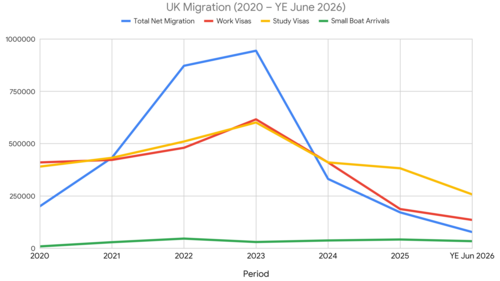
- Today's Official Figure (Nov 2026): The ONS confirms that long-term net migration has plummeted to 77,000 in the year ending June 2026 (738,000 arrivals minus 661,000 departures).
- The Main Drivers: The vast majority of arrivals come via regulated visa routes. Among non-EU+ nationals (550,000 arrivals), study remains the largest driver at 257,000 (47%), while work-related arrivals dropped by 25% to 135,000 following tightened visa rules and the end of overseas social care recruitment.
- Small Boat Crossings: Home Office quarterly statistics show 33,374 people were detected arriving via small boats in the year ending June 2026 (with year-to-date crossings in 2026 running 40% lower than the same period in 2025).
- The Proportion: For every 1 person arriving on an irregular boat crossing, roughly 22 people arrive through official channels to study, work, or join family.
2. The Historic Collapse of Net Migration
Despite widespread public perception that immigration is continually rising, official figures show that net migration has experienced one of the steepest declines in modern British history.
- The 2023 Peak: Net migration reached a revised all-time peak of 944,000 in early 2023.
- Today's Official Figure (Nov 2026): The ONS confirms that long-term net migration has plummeted to 77,000 in the year ending June 2026 (738,000 arrivals minus 661,000 departures).
- The Trend: Net migration has fallen by nearly 92% (867,000) from its 2023 peak—returning the UK to levels last seen in 1997 (excluding the Covid-19 lockdown period). This drop is driven by falling non-EU arrivals alongside international students from the 2022–2023 cohorts completing their courses and leaving the UK.
3. Our Healthcare System: Who Actually Stays?
While overall migration has sharply contracted, analysis from the independent Migration Advisory Committee (MAC) and Home Office shows how vital international professionals are to keeping public services running:
- Health and Social Care Stability: MAC findings show that 88.2% of migrants working in human health and social work still hold valid UK immigration status five years after arrival—far higher than the 76.4% average across other sectors.
- International Nurses: 94.0% of international nurses remain in the UK five years after arriving, representing one of the highest retention rates of any skilled profession.
- Protecting Existing Care Staff: Following the government's November 2026 Earned Settlement reforms—which extended the standard settlement pathway to 10 years—transitional protections were confirmed so that existing care workers and dependants who arrived under earlier rules retain their 5-year path to settlement, preventing severe staffing shortages across the NHS and social care.
| Period | Net Migration (ONS) | Total Long-Term Immigration (ONS) | Small Boat Arrivals (Home Office) |
| Calendar Year 2020 | 200,000 | 1,050,000 | 8,404 |
| Calendar Year 2021 | 432,000 | 1,160,000 | 28,526 |
| Calendar Year 2022 | 872,000 | 1,320,000 | 45,755 |
| Calendar Year 2023 | 944,000 (Peak) | 1,469,000 | 29,437 |
| Calendar Year 2024 | 331,000 | 948,000 | 36,816 |
| Calendar Year 2025 | 171,000 | 813,000 | 41,472 |
| Year Ending June 2026 | 77,000 | 738,000 | 33,374 |
Applications for British citizenship
Applications for British citizenship have more than doubled since 2017, climbing sharply after 2022 to reach a record high of just over 315,000 submissions in the year ending June 2026. This surge is driven primarily by two demographic trends: larger cohorts of non-EU migrants who arrived between 2017 and 2019 reaching the standard six-year residency threshold needed to naturalise, and a 40% year-on-year rise in EU nationals with EU Settlement Scheme (EUSS) settled status choosing to secure full citizenship. Despite an adult application fee of £1,839 (as of April 2026), long-term residents from both EU and non-EU backgrounds are increasingly opting to formalise their permanent status in the UK.
You can check eligibility requirements and submit an online application directly through the official UK Government portal: Apply for British citizenship (GOV.UK).